4DS renews IMEC contract, aims perovskite ReRAM at AI
4DS Memory Ltd. a memory technology developer listed on the Australian Stock Exchange, has renewed its R&D collaboration with the IMEC research institute after receiving positive results from its fourth lot of test chips.
4DS was founded in 2007 and has been pursuing a so-called interface switching ReRAM via a collaboration with IMEC since 2017. eeNews Europe reported this in 2017 and that 4DS has a joint development agreement with Western Digital subsidiary HGST (see IMEC to support ReRAM developer 4DS).
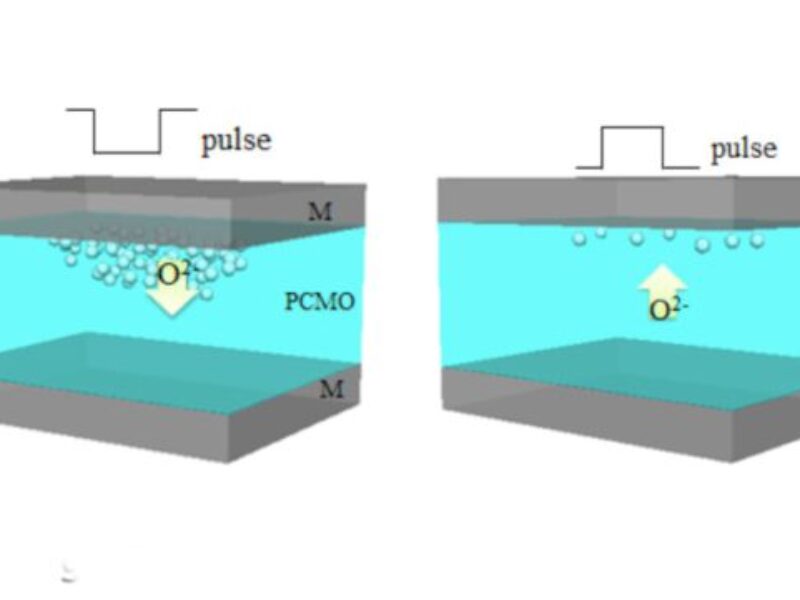
The 4DS ReRAM is based on a perovskite crystalline material made of praseodymium, calcium, manganese and oxygen (PCMO) between top and bottom electrodes. This can deliver fast write times, similar to DRAM, with endurance of 3 x 10^9 cycles and a tunable non-volatile persistence of between hours and weeks, the company claims.
4DS calls this a “ReRAM that breathes” because it contends that the transition between high- and low-resistence states is created by the sweeping of oxygen ions in and out of an interfacial layer by an electronic pulse. In addition, the company asserts that while other ReRAM technologies are filamentary, the ion-movement within its PCMO device takes place across the full area of the cross-point. The company points to a programming current that scales with cross-point area as evidence of this.
When this oxygen is present, the cell conducts and it is said to be SET. When the oxygen is removed, the current path is lost and it is said to be RESET. Because the entire interface area is involved the current density is kept at a minimum which contributes to the high endurance of the cell, the company claims.
Peter Himes, chief strategy officer, said the 4DS cell could be configured in a crossbar array but that is outside the company’s technology development path at this time.
According to the company’s interim financial for the results for the half-year ended 31 December 2023, published February 21, 2024, the company had achieved successful results with an IMEC megabit array test platform with 60nm memory cells. In the six-month period the company made a net loss of AU$1.78 million on sales revenue of AU$165,007.
The technical results were reported as:
- Write speeds at 9.5 nanoseconds which were significantly superior to DRAM
- Endurance in excess of 3 billion cycles
- DRAM read speed
- Data retention that is persistent and tuneable
The company is now claiming single-shot write time of 4.7ns to deliver low energy per bit writing at DRAM speeds.
4DS has agreed to pay IMEC €1.92 million for additional collaboration activities to be undertaken during 2024. Delivery of fifth and sixth lots of 1Mbit array chips is due in 3Q24 with the sixth lot being based on 20nm memory cells. This is approximately equivalent to an aggressive memory cell pitch that would be found in a 20nm manufacturing process technology said Peter Himes, chief strategy officer. Himes said that targeting sub-28nm manufacturing process was key to product introduction
“CPU/server systems and emerging AI processor architectures can take advantage of 4DS’ technology to develop faster and more energy and processor efficient solutions for big data and neural net applications,” said Himes, in a statement. “4DS is the only commercially viable PCMO- based technology that has demonstrated the reliable performance, speed, endurance and energy efficiency needed for next-generation big data and AI applications.”
Related links and articles:
News articles:
IMEC to support ReRAM developer 4DS
Sematech partners with RRAM startup
ReRAM achieves high-temperature qualification, first 22nm wafers
 If you enjoyed this article, you will like the following ones: don't miss them by subscribing to :