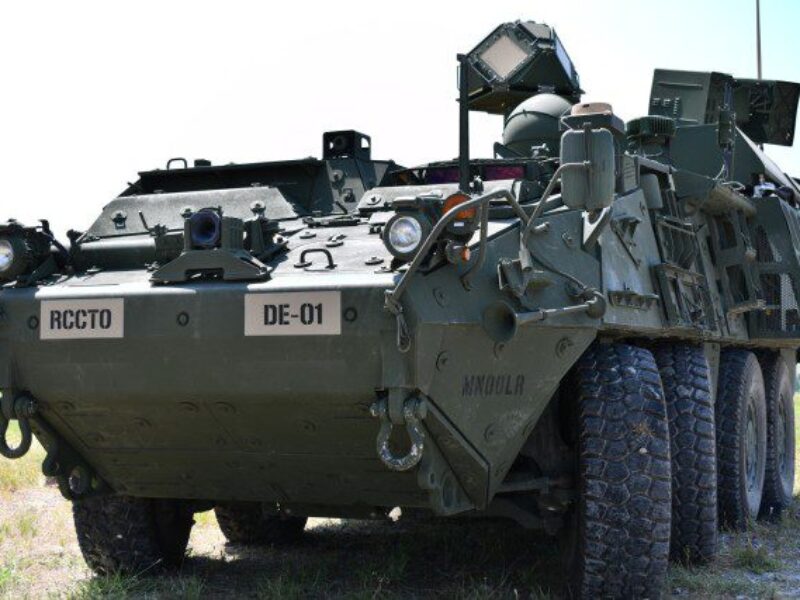
50kW high energy laser for US weapon system
 Cette publication existe aussi en Français
nLIGHT in the US has won a $34.5 million contract to provide a 50kW High Energy Laser (HEL) for a weapon system.
The 18 month contract will see nLight provide the high energy fibre laser to Kord Technologies as the prime contractor for the U.S. Army’s Rapid Capabilities Critical Technologies Office (RCCTO) Directed Energy Maneuver-Short Range Air Defense (DE M-SHORAD) project.
“High energy lasers are moving out of the lab and into the field,” said Scott Keeney, nLIGHT’s President and Chief Executive Officer.
DE M-SHORAD is a component of the U.S. Army’s broader modernization strategy for air and missile defence, integrating the 50kW-class laser weapon system onto a Stryker combat vehicle.
This aims to disable uncrewed aircraft systems; rockets, artillery, and mortar; and rotary- and fixed-wing aircraft. Compared to conventional heavy kinetic weapons, directed energy laser weapons can provide a lower cost-per-shot in a smaller footprint says nLight.
- AC induction motors and a Death Ray at the Tesla Museum
- High-energy laser counter-drone system delivered to USAF
- High power microwave gun to disable rogue drones
“DE M-SHORAD is a 50-kilowatt class laser weapon system on a Stryker vehicle,” said Damon Templet, DEVCOM AvMC software lead for DE M-SHORAD.
“In simple terms, we have an onboard thermal and power system that dissipates heat and recharges the system’s batteries. The laser is fired off the batteries. The beam comes out of a roof-mounted beam director. If you grew up on ‘Star Wars,’ it’s a little disappointing to learn that the beam makes no sound and isn’t visible to the eye. A tracking system puts the laser beam on a target and then the optimal aimpoint is maintained until the track is neutralized,” he said.
“Our integrated HEL and beam control solutions use adaptive optics to focus more power on target and maximize laser lethality,” said Jeff Barchers, President of nLIGHT Defense Systems. “Our vertically integrated approach to laser design and manufacturing enables us to control every aspect of system design. As a result, we can produce ruggedized lasers using components that are line-replaceable units and can be serviced by a soldier in the field, which we believe is critical to long-term adoption of directed energy laser weapons.”
 If you enjoyed this article, you will like the following ones: don't miss them by subscribing to :