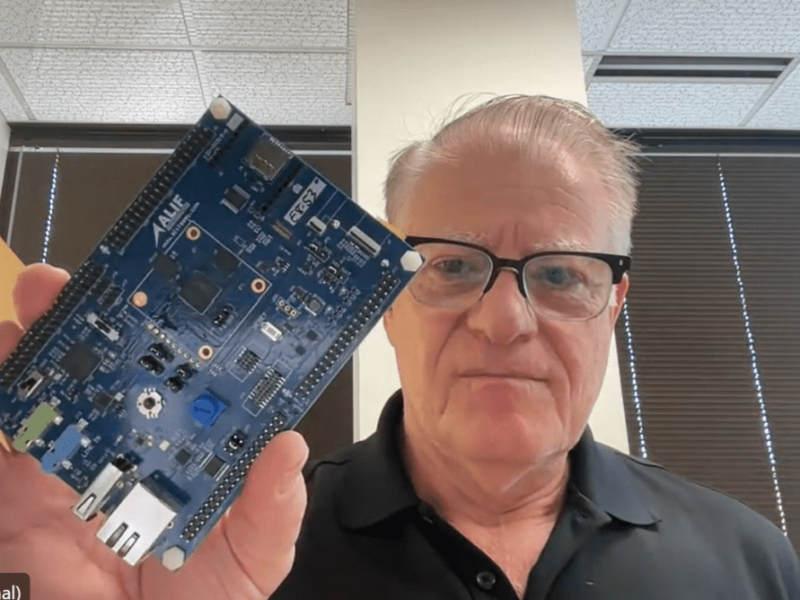
Alif ships first Ethos U85 AI microcontroller
 Cette publication existe aussi en Français
Alif Semiconductor has shipped the first microcontroller with the ARM Ethos U85 neural processing unit that can handle transformer AI models at the edge
The second generation multicore microcontroller, announced back in January, is the first to use the Ethos U85 core, alongside two Ethos U55 NPU cores in the high end E8 chip. This enables the use of small language models (SML) and transformer-based vision models. The next generation is expected to boost the performance of the U85 by up to 12x.
- ARM supports embedded transformer models with U85 NPU
- How transformer models impact edge AI chip designs
The family is built on a fully depleted silicon on insulator (FD SOI) process for low power, with 1.3 µA consumed in its STOP mode and down to 27 µA/MHz in operation. Using MRAM non-volatile memory also helps to keep the power consumption down.
“AI is a very big field and means a lot of different things to people,” Raza Kazerounian, president and co-founder of Alif Semiconductor tells eeNews Europe.
“We are really focussed on the end point. So we set out to create a scalable platform that is extremely power conscious and secure. In the second generation microcontroller the idea of running an NPU that supports transformers is very interesting.”
Using a common IP such as the U85 rather than a proprietary core is key, he says. “To bring AI to the largest number of developer sis hard enough, and the idea of using an ARM IP is interesting. I don’t believe in proprietary AI architectures as the ecosystem is less. The U85 opens up a whole new set of applications.”
Although the U85 was discussed several years ago to run transformer models, Kazerounian says the company executed faster than previous designs to implement the NPU core. However it did not use the Corstone compute subsystem that ARM has developed that combines the U85 NPU with the Cortex M85 core.
“We have a system architecture with our own power architecture and multiple power domains, system integration and the type of features so we put a lot of innovation in those areas for low power, including our security enclave, when we receive and IP like the U85 we synthesise the RTL and do the integration,” said Kazerounian. “We had a framework with a universal bus architecture so we could prepare for the IP to come in but its never easy, making sure it works with the memory and the MCU.”
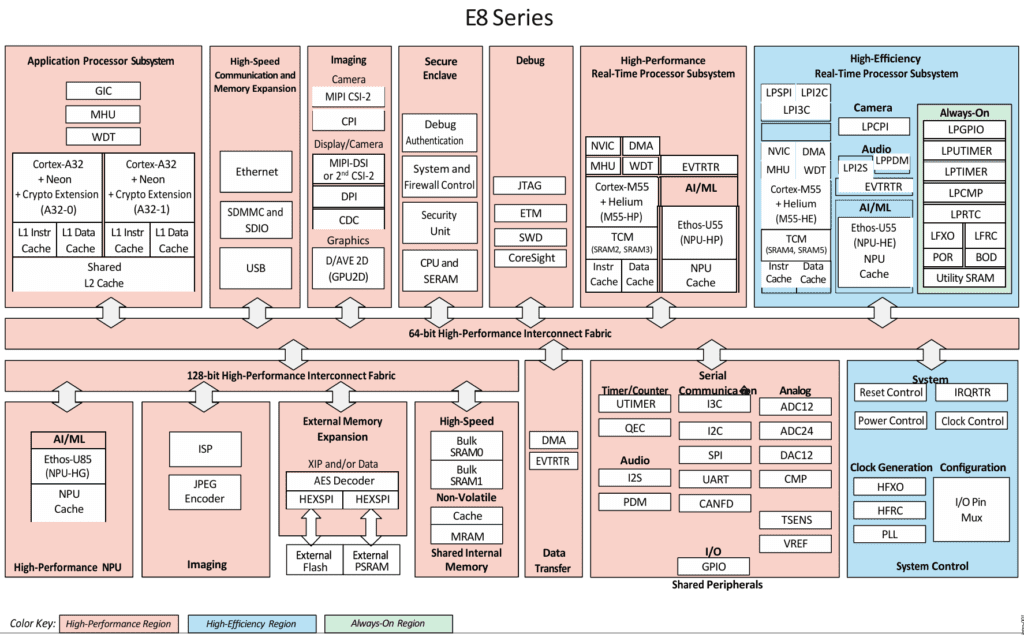
The Ensemble E8 Source: Alif Semiconductor
“We create a family of products running on the same platform with single and multicore versions, The E8 has 9Mbytes of RAM and 6Mbytes of non-vola tile memory but some SLMs can need bigger memory but we don’t want to move to 32 or 64Mbytes so we also provide a high seed bus such as hexSPI to peripherals for extra memory.”
Camera integration
The new generation parts also include an image pipeline and two MIPI CSI lines and a GPU onboard for the camera.
The current U85 core provides 204GOPS of performance but there are plans for higher performance versions.
“In the generation after this one we will enhance that more,” Kazerounian tells eeNews Europe. “We have the flexibility for the size we can implement, with 0.5TOPS, 2TOPS, 3TOPS, the U85 is a very capable core.”
The microcontrollers have dual 800MHz ARMv8 Cortex A32 application cores with a high performance 400MHz ARM M55 microcontroller core with U55 NPU and 160MHz M55 efficiency core with a U55 NPU alongside the 400MHz U85 NPU.
The Ensemble E4, E6 and E8 are available now with an E8 development board that can be partitioned into E4 and e6 versions.
“With the E4, E6 and E8 series of Ensemble GenAI products, Alif continues to push the envelope of edge AI applications. While existing market solutions are built for real-time control, and not for AI, Alif built an AI-ready architecture from the start. That’s why Alif customers are now able to use the E4, E6 and E8 devices to implement transformer-based models and generative AI in edge and endpoint products powered by a small battery,” said Kazerounian.
 If you enjoyed this article, you will like the following ones: don't miss them by subscribing to :