Bosch Sensortec and Espressif extend sensor platform work with ESP SensairShuttle
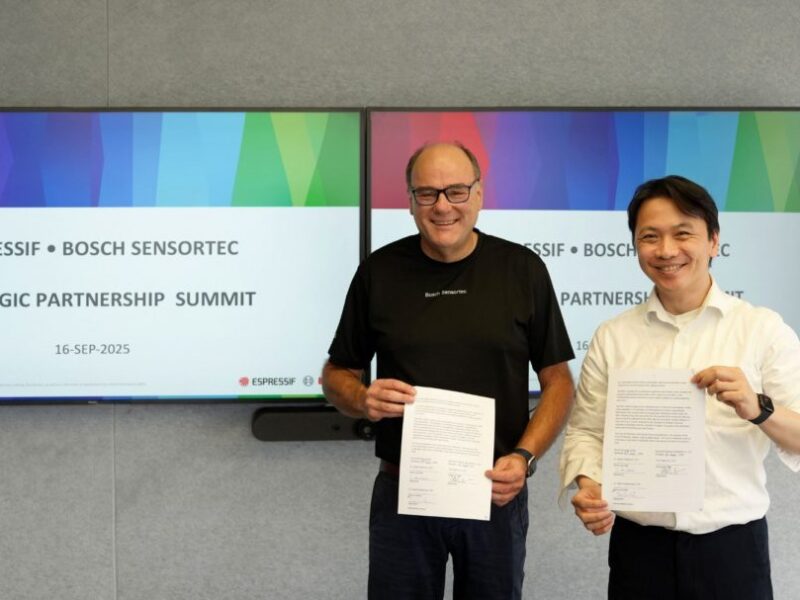
Bosch Sensortec and Espressif have signed a strategic agreement centred on a modular sensor development platform called ESP SensairShuttle. The idea is to make it quicker to prototype and validate multi-sensor designs by pairing Bosch Sensortec MEMS devices and algorithms with an Espressif wireless SoC as the controller.
Bosch Espressif partnership: what they’re actually shipping
The headline hardware is ESP SensairShuttle, built around Espressif’s ESP32-C5. It uses a shuttle-board approach: interchangeable sensor boards plug into a common base that also includes a touch display, so you can swap sensing options without respinning a PCB.
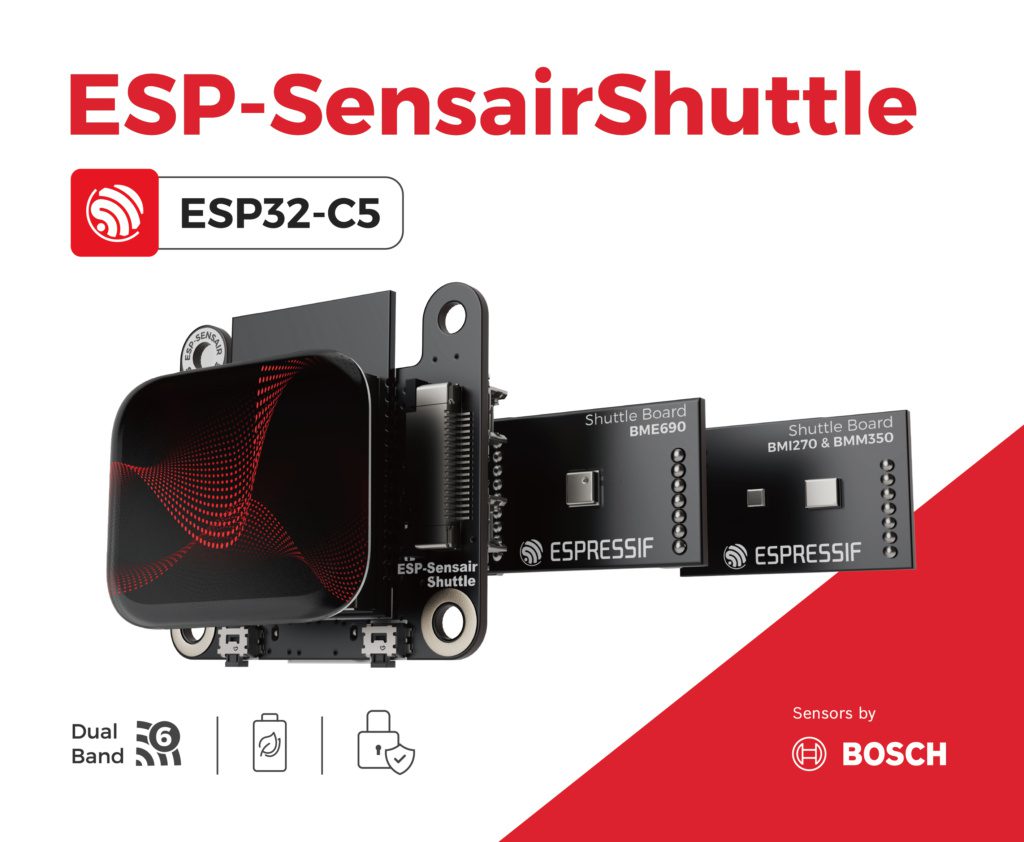
Espressif’s ESP-SensairShuttle (ESP32-C5) modular sensor platform with Bosch Sensortec shuttle boards.
Initial supported shuttles include an environmental board based on the BME690 (temperature, humidity, pressure and gas sensing, with air-quality outputs such as VOC and CO2-equivalent values) and a motion/heading combination pairing the BMI270 IMU with the BMM350 digital compass (using TMR technology for improved accuracy and low noise). The platform is described as shipping worldwide, excluding sanctioned territories.
Bosch Espressif partnership: the ESP32-C5 angle
ESP32-C5 is positioned as the “glue” that makes the platform useful beyond the bench. It’s a 32-bit RISC-V design (up to 240 MHz) with dual-band Wi-Fi 6 (2.4 GHz and 5 GHz), Bluetooth LE and IEEE 802.15.4 (Zigbee/Thread), plus the usual embedded interfaces such as I2C, SPI and UART. In other words, the sensor mixes you evaluate can be pushed straight into common IoT network topologies, not just logged over USB.
Another practical detail: Bosch “factory” firmware is preloaded so developers can pull real-time sensor data and exercise Bosch algorithms immediately, then move into ESP-IDF (and Bosch’s software components) when they start turning a demo into product code.
Beyond SensairShuttle: a second dev board for makers
Espressif’s announcement also calls out ESP-Spot, an open-source hardware design aimed at quicker validation of motion-centric interaction use cases (gesture recognition, low-power wake-up, and similar). It’s built on ESP32-C5 and integrates the BMI270 and BMM350 combination, with published hardware files and firmware intended to reduce friction for prototypes.
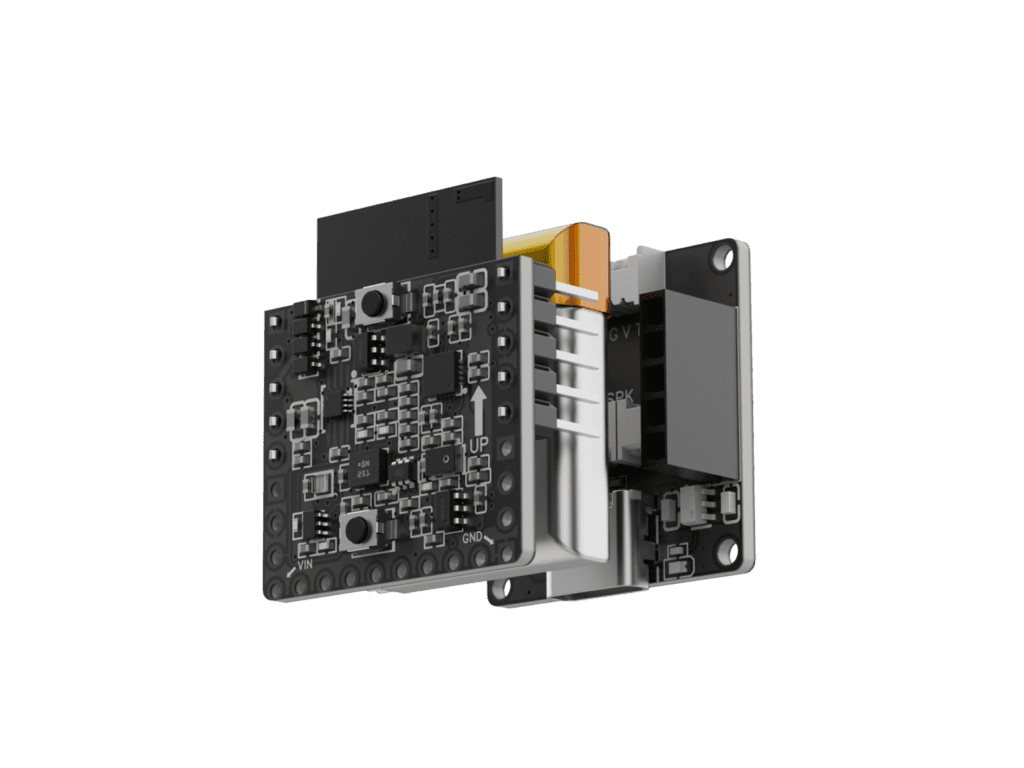
ESP-Spot: Espressif’s open-source hardware reference board shown as a compact stacked PCB module.
If you want the vendor write-up, use the full announcement. For platform specifics, the developer documentation is the most concrete starting point. Related background on embedded sensing and IoT platforms is also available on eeNews Europe’s embedded coverage.
 If you enjoyed this article, you will like the following ones: don't miss them by subscribing to :