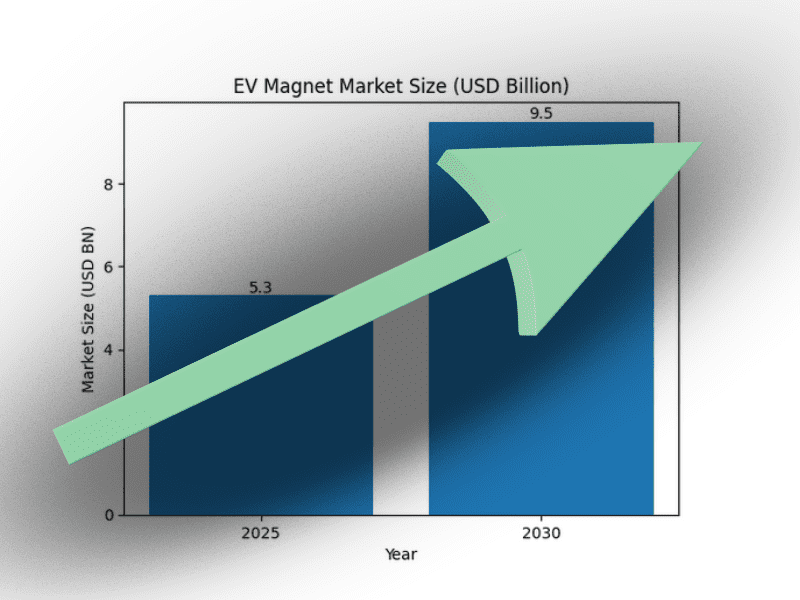
EV magnet market set to reach $9.5 billion by 2030
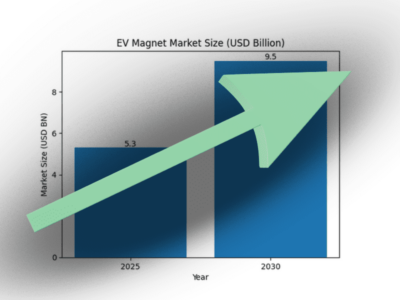
The global electric-vehicle (EV) magnet market is on a strong growth trajectory as electrification accelerates across the automotive sector. According to a new report from MarketsandMarkets, the market is projected to expand from $5.3 billion in 2025 to $9.5 billion by 2030, representing a CAGR of 12.4%.
For eeNews Europe readers working on EV powertrains, motor design, and supply chains, the data highlights key technology shifts — from magnet materials and motor architectures to regional supply developments — that will influence future EV platform design and manufacturing strategies.
Electrification and motor innovation driving demand
The EV magnet market is experiencing rapid expansion as global production of electric vehicles continues to rise. According to the release, demand is being fueled by the growing use of high-efficiency traction motors across passenger EVs, hybrid vehicles, electric buses, and light commercial vehicles.
Advances in permanent magnet materials — particularly neodymium-iron-boron (NdFeB) and samarium cobalt (SmCo) — are improving power density, torque performance, and drivetrain efficiency, the report indicates. Improvements in motor design and thermal management are also enabling higher performance in propulsion systems and auxiliary motors.
The report notes that permanent magnet synchronous motors (PMSMs) remain widely adopted in modern EV architectures. At the same time, the increasing integration of magnet-based control and sensing systems and the rollout of high-voltage EV platforms in the 400-to-800-V range are strengthening overall magnet demand.
Government incentives supporting zero-emission vehicles, expanding EV manufacturing capacity, and investments in localized rare-earth supply chains are also contributing to sustained global growth in the sector, according to the release.
Ferrite magnets gain momentum
One of the most notable trends identified in the report is the rising adoption of ferrite magnets. By magnet type, the ferrite segment is expected to grow at the fastest rate, with a projected CAGR of 12.5% between 2025 and 2030.
According to the release, automakers are increasingly exploring ferrite-based traction motor designs to reduce reliance on rare-earth materials, particularly amid price volatility in neodymium and dysprosium. Ferrite magnets are gaining traction in cost-sensitive EV platforms and in electric two- and three-wheelers, especially in the Asia-Pacific region.
Motor design innovations — such as optimized rotor topologies and improved efficiency compensation — are enabling ferrite magnets to expand into mid-power traction applications, the report indicates. Passenger electric vehicles currently dominate the market, accounting for 90.2% of EV magnet demand by value in 2024. However, according to the report, medium-power traction motors in the 60-150 kW range are expected to see significant growth as compact and mid-size EV production rises globally.
Regional dynamics and supply chains
Asia-Pacific continues to dominate the EV magnet market, holding a 79.4% share in 2024, according to the report. The region benefits from strong EV production, established rare-earth processing capabilities, and major manufacturing capacity for motors and magnets. North America is expected to hold the second-largest market share during the forecast period. According to the release, this growth is being supported by expanding EV manufacturing in the US, increased battery and e-drive production, and policy incentives tied to clean-energy and localization initiatives. Investments in domestic rare-earth processing and magnet manufacturing are also aimed at reducing supply-chain dependence on imports.
For engineers and industry professionals, the report highlights an important shift in EV motor technology and materials strategy. Growing demand for efficient traction motors, increasing use of ferrite magnets to reduce rare-earth dependence, and expanding regional magnet supply chains will directly influence EV drivetrain design, component sourcing, and long-term manufacturing planning.
 If you enjoyed this article, you will like the following ones: don't miss them by subscribing to :