
KIST researchers overcome supercapacitor limitations
A research team comprised of Dr Bon-Cheol Ku and Dr Seo Gyun Kim from the Carbon Composite Materials Research Center at the Korea Institute of Science and Technology (KIST), along with Professor Yuanzhe Piao from Seoul National University (SNU), have developed a cutting-edge supercapacitor that surpasses the limitations of existing models by utilising a novel fibre structure that combines single-walled carbon nanotubes (CNTS) with the conductive polymer polyaniline (PANI).
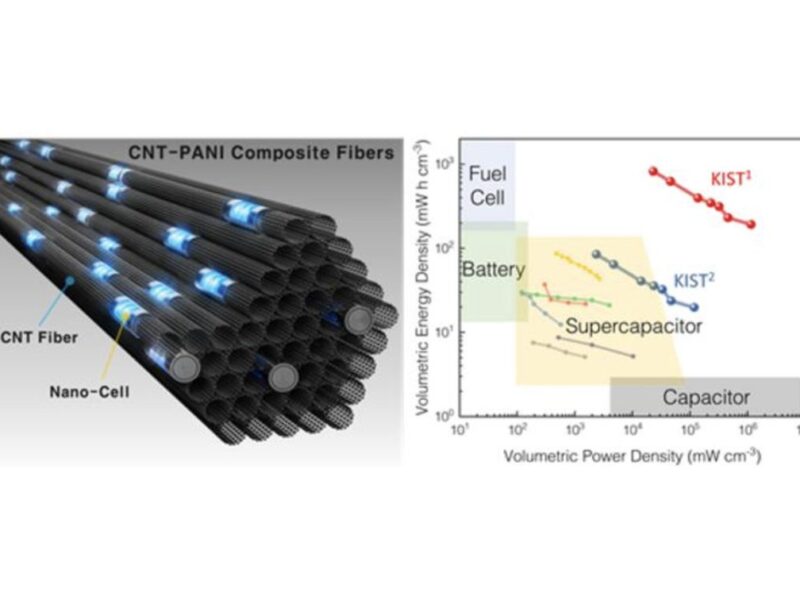
Typical batteries charge slowly, but supercapacitors feature rapid charging capabilities and higher power output while exhibiting minimal degradation over thousands of charge and discharge cycles. However, their comparatively low energy density has limited their application, particularly in powering long-duration devices such as electric vehicles and drones. The research team addressed this limitation by chemically bonding single-walled carbon nanotubes, known for their high conductivity, with the adaptable and cost-effective polymer polyaniline on a nanoscale. This innovative combination produces a sophisticated fibre structure that improves both electron and ion flow, thus creating a supercapacitor capable of storing more energy and releasing it quickly.
An ideal substitute or complement to battery systems, the newly developed supercapacitor remains efficient and reliable even after over 100,000 charging cycles, maintaining stability in high-voltage conditions. The composite CNT-PANI fibre also features significant mechanical flexibility, enabling it to be rolled or folded, making it suitable for next-generation electronic devices, such as wearable devices. In electric vehicles, this technology could enhance power delivery efficiency, improve charging speed, and consequently extend range and performance. Other possible applications include drones and robots.
In addition, the researchers have reduced the production costs historically associated with single-walled carbon nanotubes, overcoming a major barrier to commercialisation. Integrating CNTs with low-cost polyaniline simplifies the production process and could facilitate mass production. The research team have already created film-like structures that prepare this technology for commercialisation. This development is poised to play a crucial role in enabling a transition to a carbon-neutral future across various sectors, including electric vehicles, robotics, drones, and wearable technology.
“This technology overcomes the shortcomings of supercapacitors by using single-walled carbon nanotubes and conductive polymers,” said Dr. Bon-Cheol Ku of KIST. “We will continue to develop and industrialise ultra-high-performance carbon fibres based on carbon nanotubes.”
Image: (Left) Schematic illustration of a composite of CNTs and PANIs. It demonstrates that the covalently bonded PANIS are evenly distributed among the CNTS and that each PANI can function as a nanoscale cell. (Right) The composite fibre fabricated based on these characteristics demonstrates excellent power and energy density simultaneously, exceeding the performance of general supercapacitors. (KIST1 is the value calculated by the weight of only PANI, and KIST2 is the value calculated by the weight of the fibre.) Credit: Korea Institute of Science and Technology (KIST).
https://doi.org/10.1016/j.compositesb.2025.112179
 If you enjoyed this article, you will like the following ones: don't miss them by subscribing to :