Michigan University quantum testbed opens remote access for researchers
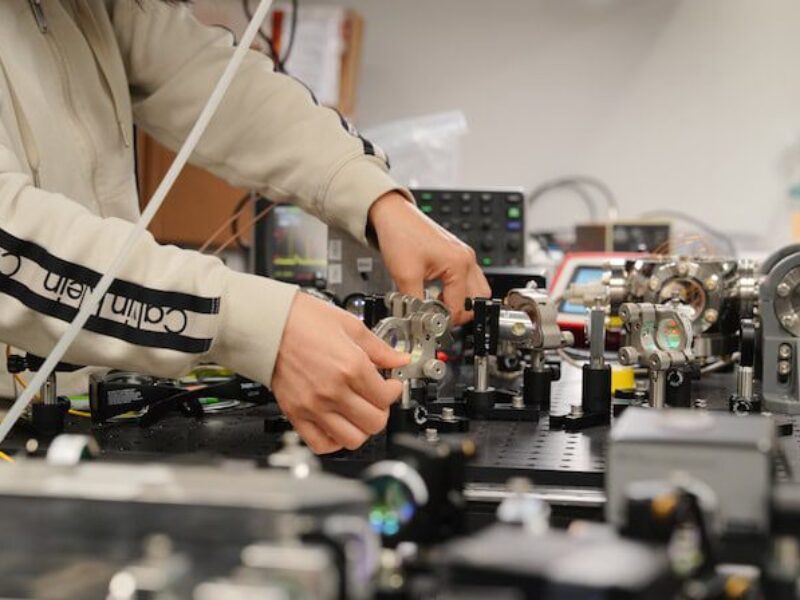
The University of Michigan (U-M) has launched a quantum testbed that links two campus labs via optical fiber, creating the first piece of a local quantum network and a platform for remote experimentation.
For eeNews Europe readers, this marks a step toward democratizing quantum R&D. By lowering the barrier to accessing quantum hardware, U-M’s testbed could accelerate progress in quantum communications, cryptography, and computing.
First fiber link for quantum experiments
The new connection links the labs of associate professors Zheshen Zhang and Parag Deotare, three miles apart on the Ann Arbor campus. Using optical fibers, their teams can transfer encrypted or entangled information between facilities in real time.
“You can think about this link as an extension of the current Internet, with telecommunication fibers transmitting optical signals, but now we have the new capability to distribute quantum states of light in addition to classical states of light,” said Zhang.
The team has already demonstrated entangled light transport across the fiber, a milestone that typically requires rare, high-end facilities. Researchers hope that remote access to the system will open the door for more complicated entanglement schemes involving multiple particles.
“I’m looking forward to the opportunity to test real life quantum entanglement on multiple levels,” said Alexander McFarland, a PhD student who works in Deotare’s lab. “We will have the opportunity to try for more complicated entanglement schemes, ones which involve more than two particles and can push the field of quantum cryptography farther.”
Cloud-based education and collaboration
In addition to research, the platform serves as a teaching tool. Pre-recorded datasets from actual experiments are available at qreal.cloud, allowing students to match theory with experimental results.
“What excites me most about this testbed is that it allows people to experience quantum physics firsthand,” said Visuttha Manthamkarn, a PhD student in Zhang’s lab. “Instead of just learning about concepts like entanglement in theory, students and researchers can now explore real data from photons that are linked across campus.”
The infrastructure also paves the way for collaboration with local universities and industry. U-M is working with Merit Network, a regional service provider, to extend connections to community colleges and industrial partners.
“One of the greatest challenges we faced was figuring out how to combine extremely delicate quantum-optics hardware with the kind of robust cloud infrastructure that users expect to be stable and dependable,” explained PhD student Kailu Zhou, who led the cloud interface development. “We overcame this by carefully designing multiple layers of control, adding automated calibration and monitoring, and ensuring that timing and precision were maintained.”
Toward a regional quantum network
Zhang and Deotare see the testbed as the backbone of a future distributed quantum network. Plans call for connecting more labs using different quantum platforms such as trapped ions, superconducting qubits, and 2D materials already under study at Michigan.
“If we can create a portal that allows external users to remotely access the testbed resources, that greatly facilitates technology advancement and technology transfer,” Zhang said.
Deotare added that the project also supports workforce development: “The distributed network that we’re creating would serve as excellent infrastructure for industry folks to visit and spend a couple of weeks trying to understand quantum experiments at a distributed network level and getting experience with an actual system.”
The U-M Office of the Vice President for Research funds the initiative, and the National Science Foundation supports its educational aspects.
 If you enjoyed this article, you will like the following ones: don't miss them by subscribing to :