Molex targets AI data centres with co-packaged copper solutions
As hyperscale data centres scale to support AI and high-performance computing, signal integrity and power efficiency are becoming critical design constraints. Molex has introduced copper solutions as a connectivity platform aimed at addressing these challenges in next-generation server architectures.
For eeNews Europe readers designing high-speed interconnects or data-centre hardware, the development highlights how copper-based solutions may continue to evolve alongside optical technologies in AI infrastructure.
Co-packaged architecture for high-speed copper solutions
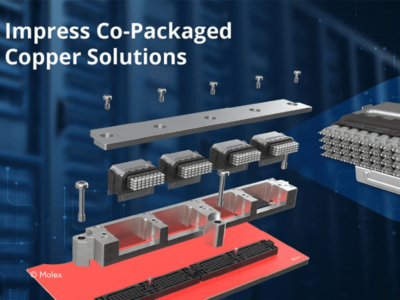
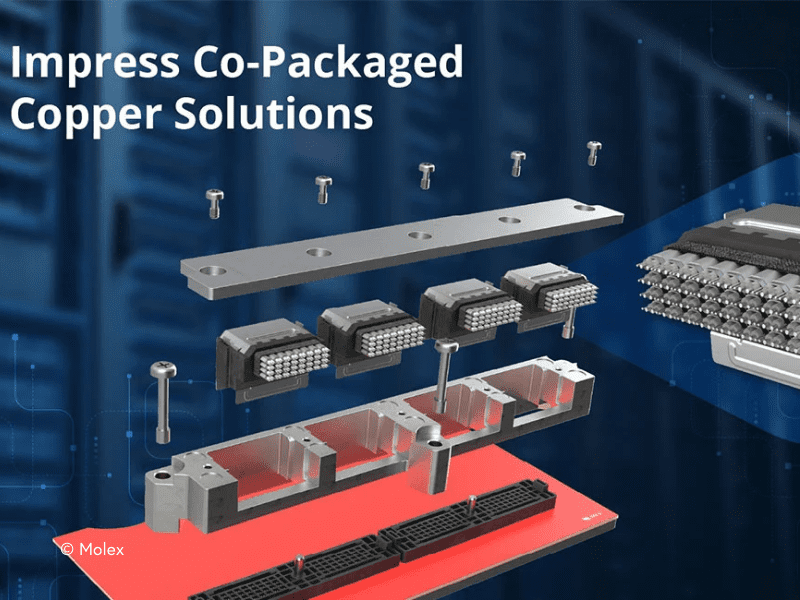
Molex has introduced its Impress platform, a connector and cable system designed to support ultra-high-speed communication between ASICs and external connectivity. The approach places the interconnect directly on the ASIC package substrate, shortening signal paths across the printed circuit board and potentially reducing signal loss and crosstalk.
The system uses a compression-attached socket combined with a mating cable assembly to enable high-speed data transfer for data-centre equipment. According to the company, the architecture supports transmission speeds of up to 224Gbps PAM-4 and is designed with scalability in mind for future network generations.
“As AI workloads push data centres to their physical limits, we are focused on maximising efficiency without sacrificing signal integrity,” said Jairo Guerrero, VP & GM, Copper Solutions, Molex. “Impress is our latest innovation built to help scale infrastructures without exponential increases in power consumption or cost. By enabling high performance at the rack level, Molex is making next-generation compute more technically and economically viable.”
Designed for emerging AI and 224G ecosystems
The Impress co-packaged copper platform is part of Molex’s broader portfolio of high-speed interconnect technologies targeting the transition to 224G networking and beyond. These higher data rates are increasingly required as AI training, large language models and cloud services drive rapid growth in data-centre bandwidth.
The connector system is designed to simplify system maintenance and upgrades by allowing the socket to attach to the substrate without damaging it. Molex says the approach can also support rework and maintenance operations more easily, which may be valuable in complex server platforms.
Impress builds on the company’s earlier NearStack On-the-Substrate connector technology, which moved high-speed paths closer to the processor to reduce latency and improve space efficiency in dense server designs. Molex reports that more than one million NearStack units have already been deployed in data-centre environments.
The current implementation supports 224Gbps PAM-4 applications, with development work underway to validate the architecture for future 336G and 448G signalling speeds.
 If you enjoyed this article, you will like the following ones: don't miss them by subscribing to :