Raspberry Pi launches its first RISC-V multicore chip
 Cette publication existe aussi en Français
Raspberry Pi has stepped up its chip development with a quad core microcontroller with two ARM Cortex-M33 cores and two in-house RISC-V cores.
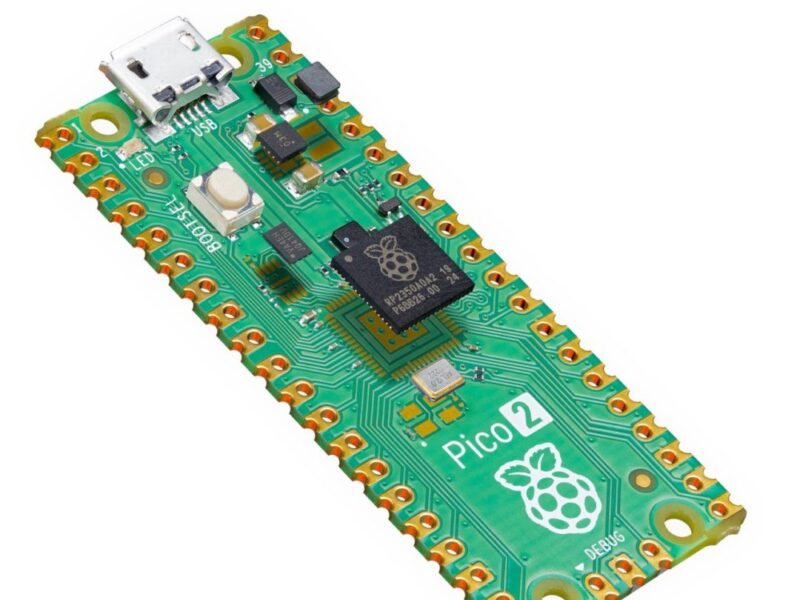
The $5 Raspberry Pi Pico 2 board uses the RISC-V RP2350 microcontroller and will be followed by a wireless version, the Pico 2 W with a modem from Infineon Technologies.
The RP2350 is twice the die size, has a higher core clock speed at 150MHz, twice the memory at 520KB of SRAM in ten banks and new security features compared to the RP2040 launched over three years ago with two M0+ cores. The die size is 5.3mm2, versus 2mm2 for RP2040, but the smallest version RP2350A will be just ten cents more expensive, costing $0.80 in 3,400-unit reels, or $1.10 in single-unit quantities.
Alongside the M33 cores, the RP2350 adds two RISC-V cores that can be allocated at boot time. The boot ROM auto-detects the architecture for a second-stage binary and reboots the chip into the appropriate mode.
The Hazard3 cores were developed by Luke Wren, currently a Principal Engineer in the Raspberry Pi chip team, in his free time using the RISC-V open instruction set architecture (ISA) with a highly optimised three-stage pipelined processor. This implements the RV32I instruction set, and a large collection of standard extensions targeting performance and code density. All features of the chip, apart from a handful of security features, and the double-precision floating-point accelerator, are available in RISC-V mode.
This gives software developers a chance to experiment with the RISC-V architecture in a stable, well-supported environment, and to popularize Hazard3 as a clean, open core, suitable for use in other devices, or as a basis for further development, says the company.
The security architecture is built around Arm TrustZone for Cortex-M, and includes signed boot support, 8KB of on-chip antifuse one-time-programmable (OTP) memory, SHA-256 acceleration, a hardware true random number generator (TRNG)
The chip also includes an on-chip switch-mode power supply and low-quiescent-current low drop out (LDO) regulator developed with Dolphin Design in France.
Moving from the single 7×7mm, QFN56 package option for the RP2040, the RP2350 offers a 7×7mm, QFN60 package (RP2350A) with 30 GPIOs, or a 10×10mm, QFN80 package (RP2350B) with 48 GPIOs; and variants of each with 2MB of stacked-in-package QSPI flash (RP2354A and RP2354B).
While there is relatively little stock in channel today, Pico 2 is in full-rate production at Sony. Before the end of the year, we expect to ship a wireless-enabled Pico 2 W, using the same Infineon 43439 modem as Pico W, and versions of both Pico 2 and Pico 2 W with pre-installed 0.1-inch headers.
The Pico 2 and RP2350 is supported by an updated release of the Pico SDK, and by new MicroPython and CircuitPython images. The Trusted Firmware project is aiming to establish RP2350 as the reference hardware platform for the Trusted Firmware-M 2.1.0 Long Term Support release and TF-M provides a reference implementation for PSA Certified on Arm v8-M chips, providing developers with an easy route to secure devices against common attacks.
Google’s Pigweed SDK has also added native support for Pico 2. The middleware libraries have shipped in millions of devices, including Google’s own Pixel devices and Nest thermostats.
Other boards with the RP2350
Board makers using the RP2350 include Seeed, SparkFun and 4D Systems for high-performance displays from 24″ to 7.0″ with touch and non-touch options, as well as the Adafruit Metro RP2350 to add Arduino-compatible shields and accessories, and the Bus Pirate 5XL and Bus Pirate 6 open-hardware debugging tools.
Cytron has developed a an industrial-grade I/O controller powered by RP2350 and a robot controller, while the Hellbender Raspberry Pi RP2350 development board is designed to be a general purpose microcontroller and sensor board. Wiznet is also offering evaluation boards for their W5100S, W5500, and W6100 Ethernet chips based on RP2350.
The RP2350 will be generally available in volume before the end of 2024. The samples programme is on the Raspberry Pi product page.
 If you enjoyed this article, you will like the following ones: don't miss them by subscribing to :