Researchers develop semiconductors for experimental physics
 Cette publication existe aussi en Français
Situated inside a 17-mile-long tunnel that runs in a circle under the border between Switzerland and France, the Large Hadron Collider (LHC) accelerates particles close to the speed of light before smashing them together. The resulting collisions produce an enormous amount of data, and enough radiation to scramble the bits and logic inside semiconductors or almost any piece of electronic equipment.
That presents a challenge to CERN’s physicists as they attempt to probe deeper into the mysteries of the Higgs boson and other fundamental particles. Off-the-shelf semiconductors and components cannot withstand the harsh conditions inside the accelerator, and the market for radiation-resistant circuits is too small for commercial chip manufacturers to support.
“Industry just couldn’t justify the effort, so academia had to step in,” according to Peter Kinget, the Bernard J. Lechner Professor of Electrical Engineering at Columbia Engineering. “The next discoveries made with the LHC will be triggered by one Columbia chip and measured by another.”
Kinget leads the team that designed specialised silicon chips that collect data in one of the harshest environments in particle physics.
“These sorts of collaborations between physicists and engineers are essential to advancing our ability to explore fundamental questions about the universe,” according to John Parsons, professor of physics at Columbia University and leader of the Columbia team working on the ATLAS detector, one of the LHC’s massive instruments. “Developing state-of-the-art instrumentation is crucial to our success.”
The team designed analogue-to-digital converters, or ADCs, to capture electrical signals produced by particle collisions inside CERN’s detectors and translate them into digital data that researchers can analyse.
The electrical pulses generated by particle collisions in the ATLAS detector are measured using a device called a liquid argon calorimeter. This large vat of ultra-cold argon captures an electronic trace of every particle that passes through. Columbia’s ADC chips convert these delicate analogue signals into precise digital measurements, capturing details that no existing component could reliably record.
“We tested standard, commercial components, and they just died. The radiation was too intense,” says Rui (Ray) Xu, a Columbia Engineering PhD student who has worked on the project since he was an undergraduate at the University of Texas. “We realised that if we wanted something that worked, we’d have to design it ourselves.”
The team used commercial semiconductor processes validated by CERN for radiation resistance and applied innovative circuit-level techniques. They carefully chose and sized components, and arranged circuit architectures and layouts to minimise radiation damage. They also built digital systems that automatically detect and correct errors in real-time. Their resulting design is resilient enough to withstand the unusually severe conditions at LHC for more than a decade.
Two Columbia-designed semiconductors are expected to be integrated into the ATLAS experiment’s upgraded electronics. The first, called the trigger ADC, is already operating at CERN. This chip, initially described in 2017 and validated in 2022, enables the trigger system to filter approximately a billion collisions per second and instantly select only the most scientifically promising events to record. It serves as a digital gatekeeper deciding what merits deeper investigation.
The second semiconductor, the data acquisition ADC, recently passed its final tests and is now in full production. The chip, which was described in an IEEE paper earlier this year, will be installed as part of the next LHC upgrade. It will very precisely digitise the selected signals, enabling physicists to explore phenomena like the Higgs boson, whose discovery at CERN made headlines in 2012 and led to the Nobel Prize in physics in 2013, but whose exact properties still hold mysteries.
Both semiconductors are the result of direct collaboration between fundamental physicists and engineers.
It further created opportunities to collaborate across multiple institutions. The chips were designed by electrical engineers at Columbia and at the University of Texas, Austin, in close collaboration with physicists at Columbia’s Nevis Laboratories and the University of Texas, Austin.
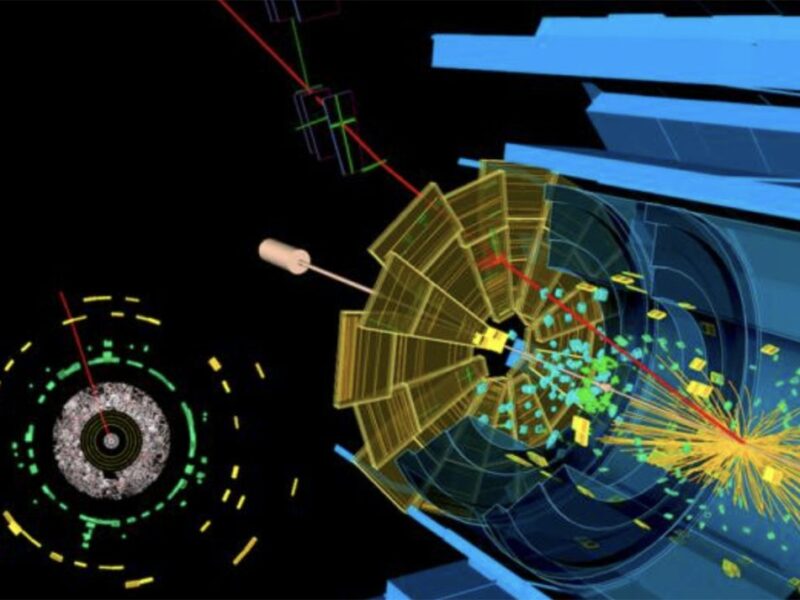
Image: The team’s chip processes information from millions of collisions each second. Credit ATLAS Experiment. Copyright 2025 CERN
Paper: https://doi.org/10.1109/OJSSCS.2025.3573904
 If you enjoyed this article, you will like the following ones: don't miss them by subscribing to :