Vector and QNX platform targets SDV software complexity
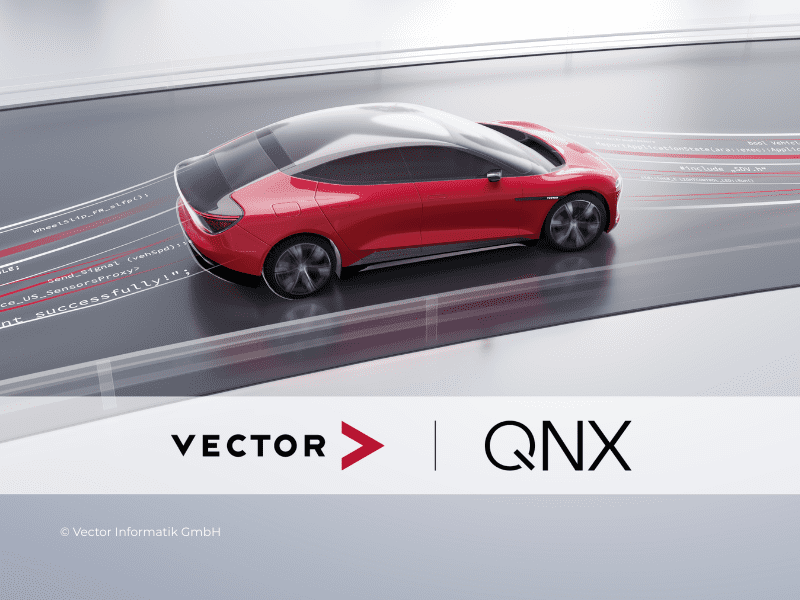
Automotive software complexity continues to rise as vehicle architectures shift toward software-defined vehicles, increasing pressure on OEMs to streamline foundational software layers. At CES 2026, Vector and QNX have presented Alloy Kore, a jointly developed vehicle software platform intended to address these challenges, with Mercedes-Benz among the early OEMs exploring its use. For eeNews Europe readers, the announcement highlights how core platform consolidation could influence future SDV architectures, development workflows, and supplier strategies, particularly in Europe’s premium automotive segment.
Foundational platform for software-defined vehicles
Alloy Kore is positioned as a base-layer vehicle software platform that combines QNX’s safety-certified operating system and virtualization technology with Vector’s middleware and tooling. The partners say the aim is to reduce the integration effort typically associated with assembling foundational SDV software stacks, potentially allowing OEMs to focus engineering resources on higher-level vehicle functions and applications.
According to the companies, Alloy Kore is designed to support centralized, high-performance compute architectures and to decouple hardware and software development cycles. This approach could be relevant as European automakers increasingly move toward zonal or centralized E/E architectures while maintaining compliance with functional safety and cybersecurity requirements.
John Wall, President of QNX, said: “The complexity of SDV development is growing exponentially, but the solution isn’t to build more – it’s to build smarter.” He added that abstracting foundational software complexity could allow OEMs to concentrate on brand-differentiating features rather than infrastructure.
Early access and OEM interest
Vector and QNX have made an early access version of Alloy Kore available through their respective distributions. Mercedes-Benz is cited as one of the OEMs evaluating the platform for next-generation SDV programmes, particularly in the context of centralized control units and over-the-air software updates.
The companies state that the platform is being developed to meet functional safety requirements up to ISO 26262 ASIL D and cybersecurity standards aligned with ISO/SAE 21434, with a certified release planned for late 2026. Alloy Kore is also intended to serve as a reference architecture for industry initiatives such as Eclipse S-CORE and SOAFEE, potentially supporting broader ecosystem alignment.
Matthias Traub, President and Managing Director at Vector, said the platform could help OEMs avoid repeatedly rebuilding core software layers across vehicle programmes, describing Alloy Kore as a way to support more modular and application-focused SDV development.
 If you enjoyed this article, you will like the following ones: don't miss them by subscribing to :